Safety
What protects you here — and what nothing can
Every claim below is a mechanism you can check by using the product, not a promise about our intentions. The last section is the one most safety pages leave out.
- 480 px
- The width a locked preview is downscaled to before the blur — on our servers, so the detail is gone from the file
- 14 days
- Earnings mature before they can be withdrawn, so a reversed payment does not land on you
- 0
- Verification documents shown to buyers, ever
What is actually built
Your content
The two ways foot content leaks are a preview that can be recovered and a file that carries where it was shot.
Previews are destroyed, not covered up
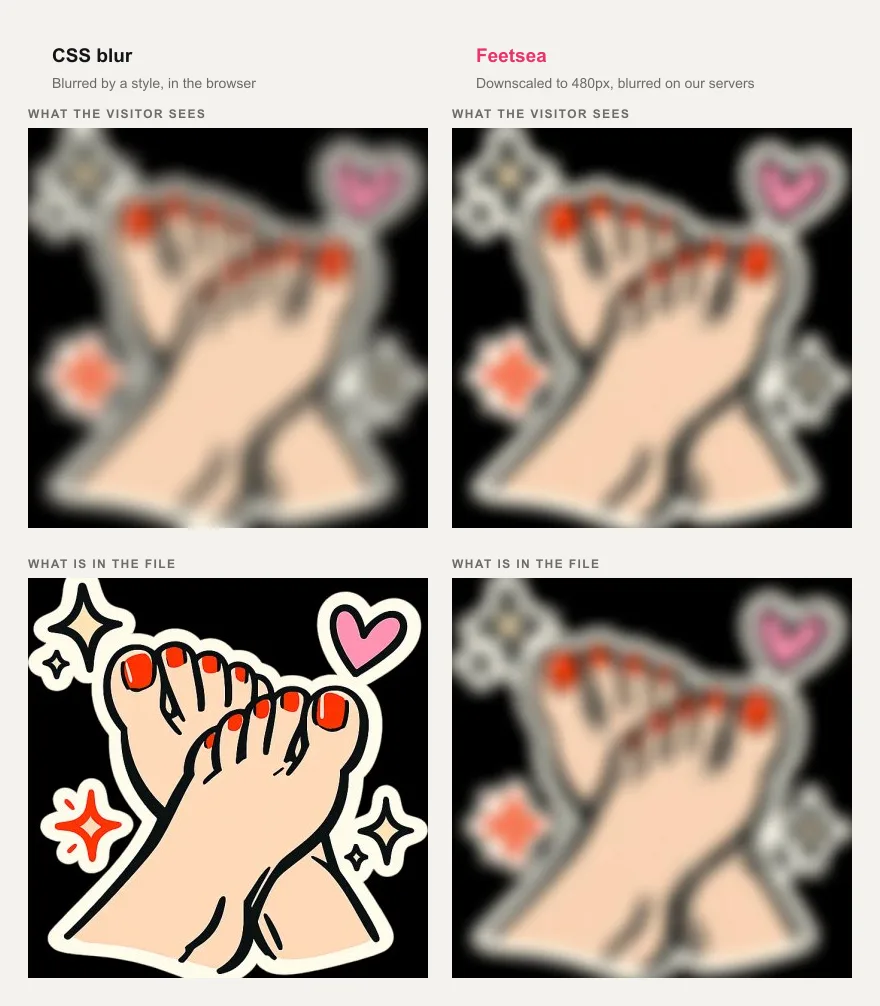
A locked preview is downscaled to 480 pixels wide before the blur is applied, on our servers. The detail is gone from the file itself, so there is nothing to sharpen back — unlike a CSS blur, which ships the full image to the browser and hides it with a style anyone can remove.
Metadata is stripped on upload
Phone photos carry EXIF, and EXIF carries GPS coordinates of where the shot was taken. We do not copy metadata into the stored file. Orientation is applied and then discarded, so pictures are the right way up without keeping the tag that says so.
Originals are never served to a browser unpaid
Full-resolution files sit in private storage and are handed out through short-lived signed links only after a purchase. A buyer who has not paid has never received the file, so there is nothing in their cache to keep. Up to 3 photos per album can be left open as a preview — that choice is yours, per album.
Your identity
Verification exists to keep minors and impersonators out. It is not a reason to show your documents to anyone else.
Documents are seen by review, never by buyers
Publishing requires a government document and a selfie holding it, reviewed by a person. That check is between you and our review team. Your legal name is not displayed anywhere on the platform, and buyers see the handle you chose.
Your face is never required in what you sell
Nothing about the product asks for it. Verification is a separate, private step from the content you publish, and the two are never shown together.
Rejections say what to fix
A failed check comes back with a fixed reason — the selfie does not match the document, the document is not visible — rather than a blank refusal. The list is finite by design, so a rejection tells you what to redo instead of leaving you guessing.
Your money
Most of what people call a scam in this market is one of three things: a buyer who disappears with the files, a payment reversed after delivery, or a deal moved somewhere with no record.
The platform holds the payment, not the buyer
Payment, delivery and messaging all happen here. A buyer cannot receive an album without the money having moved first, which removes the single most common failure — sending files and then being ghosted.
Earnings mature 14 days
A sale lands in your pending balance immediately and becomes withdrawable after 14 days. That wait is the chargeback window: if a payment is reversed after you have already withdrawn, someone absorbs the loss, and this way it is neither you nor the next creator in the queue. Withdrawals start at $50.
Moving a deal off-platform gives up all of this
A buyer who asks to pay by direct transfer, gift card or another app is asking you to give up the only record of the transaction. Sometimes the request is innocent. The protection you lose is the same either way.
Your inbox
An open inbox is useful right up until it is not.
Anyone can be blocked, at any point
Blocking is one action and does not require a reason or a purchase history. A blocked account cannot start a new conversation with you.
Rate limits cap what one account can do
New conversations per hour and messages per minute are both capped — 20 messages a minute per account. The point is not politeness: it makes bulk messaging from a fresh account impractical.
The same four numbers, compared across platforms: what each one charges and holds back.
The part most pages skip
What we cannot do
Everything above has a limit. Here are the ones that matter, stated plainly rather than left for you to find out.
A buyer can reshare what they legitimately bought
Once someone has paid and received a file, it is on their device. No platform in this market can prevent that, and any platform claiming it can is selling you something. What a platform can do is make the unpaid path useless, and that is what the preview and delivery design above is for.
We cannot verify who is behind a buyer account
Creators pass a document check because they are paid. Buyers are not held to that standard on any platform in this niche, ours included. Treat an unusually pushy request as what it is, and use the block.
Nothing here is legal or tax advice
Whether income from this is taxable, and how, depends on where you live. That is a question for a local accountant, and we deliberately do not pretend to answer it.
Questions people actually ask
- What is the safest site to sell foot pics?
- Rather than take our word for it, check four things on any platform: does the payment go through the platform or between you and the buyer; is the preview destroyed server-side or hidden in the browser; are earnings held against chargebacks; and is there a written payout minimum and timeline. A platform where the sale happens in private messages has none of the four, whatever its homepage says.
- How do I sell foot pics without getting scammed?
- The three failures that account for most of it: delivering before payment clears, moving the conversation to another app, and accepting a payment method that can be reversed. All three disappear if the transaction stays on a platform that holds the money — which is also why platforms that take no commission cannot offer this protection: they are not in the transaction at all.
- Can I sell without showing my face?
- Yes. Verification documents go to our review team and are never shown to buyers, and nothing in the product requires your face in the content you sell.
- What happens if a buyer disputes a payment?
- Earnings stay in a pending balance for 14 days before they can be withdrawn, which is roughly the window in which a card payment can be reversed. If a dispute lands inside that window, it comes out of the pending balance rather than out of money you have already been paid.